<img src="https://secure.leadforensics.com/51974.png" style="display:none;">

Experience the power of our Dynamics 365 Finance & Operations (D365 F&O) integration

Automate invoice processing, synchronise master data and postings in real time, and keep full control of finance operations across Dynamics 365 Finance & Operations.

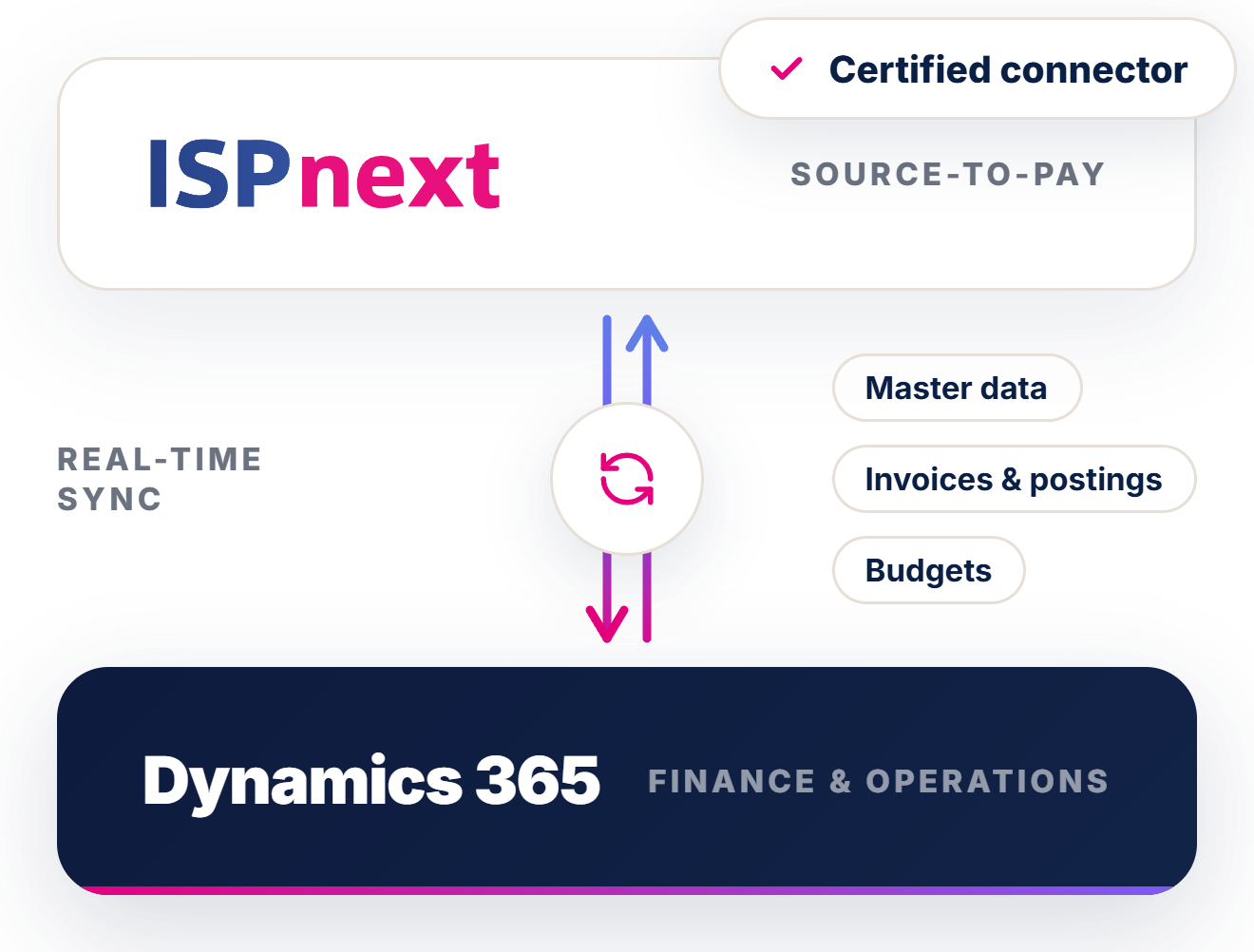
ISPnext integrates seamlessly with D365 F&O. While D365 F&O remains your single source of truth for master data and financial postings, ISPnext enhances the endtoend Source-to-Pay process with automation, visibility, and compliance. Purchase orders, goods receipts, invoices, supplier data, and postings synchronise automatically, reducing manual work and raising data quality.

Dynamics-365-Logo-2016

Benefits of the D365 F&O integration

Our integration brings finance and procurement together in one unified, accurate process. You accelerate invoice throughput, detect exceptions earlier, and keep ERP data consistent.
Icon_Business services_2x

Low IT effort, faster deployment

Standardised APIs and proven connectors mean minimal IT involvement and a short timetovalue.

Pictogram_Realtime-inzichten_paars

Realtime insight into invoices and liabilities

Invoices, POs, receipts, and master data are processed in real time so finance always works with uptodate information.

Icon_Dashboard_2x

Seamless synchronisation to keep ERP data up to date

Automatic synchronisation keeps master data, postings, and transactions aligned between ISPnext and D365 F&O, preventing inconsistencies.

Go live in 5 steps: D365 F&O integration

A predictable, lowrisk path to production.

1. Scope & processes

2. Data mapping

3. Connectivity & security

4. Testing

5. Golive + monitoring

ISPnext-4803

1. Scope & process design (Source‑to‑Pay / AP)

The first step defines the functional scope of the D365 F&O integration. This includes PO‑driven and non‑PO invoice flows, project coding, compliance requirements and approval structures. By aligning finance and procurement upfront, a clear and governed Source‑to‑Pay process is established. This prevents fragmented workflows and reduces risk later in the implementation. A clearly defined scope ensures predictable automation within Dynamics 365 Finance & Operations.

Stockphoto_Dirk Jan_Paul Johan

2. Data mapping (master data, invoices, orders, receipts, postings)

All relevant data elements are mapped to D365 F&O structures, including suppliers, chart of accounts, VAT codes, payment terms, purchase orders, goods receipts and financial postings. Accurate data mapping ensures consistent processing and high data quality. D365 F&O remains the system of record, while ISPnext uses the same data to automate and control downstream processes.
Stockphoto_Angela_Lielle_Erik_Aaron

3. Connectivity & security (roles, audit trail, permissions)

The integration is technically configured using D365 F&O APIs, including roles, permissions and security settings. A complete audit trail is established to capture every action and decision. This guarantees controlled access, traceability and compliance. It enables organisations to meet audit and governance requirements without adding complexity to the ERP landscape.
Stockphoto_Eric

4. Testing (matching, reversals, exception handling)

Before go‑live, all key scenarios are tested, including automatic invoice capture, 2‑way and 3‑way matching, reversals, corrections and exception flows. Thorough testing ensures reliability and trust in automation. Finance teams can rely on the system to process standard transactions automatically while flagging only true exceptions.
Stockphoto_Paul Johan_Dirk Jan_Didi

5. Go‑live + monitoring (performance, alerts, support)

After go‑live, synchronisation, performance and alerts are continuously monitored. Exceptions and matching results are tracked to ensure ongoing stability and accuracy. Ongoing monitoring ensures a scalable, low‑risk integration that continues to deliver control, visibility and compliance as transaction volumes grow.
Data visualisation ISPnext and Microsoft Dynamics D365 F&O

How the integration between ISPnext and Microsoft D365 F&O works

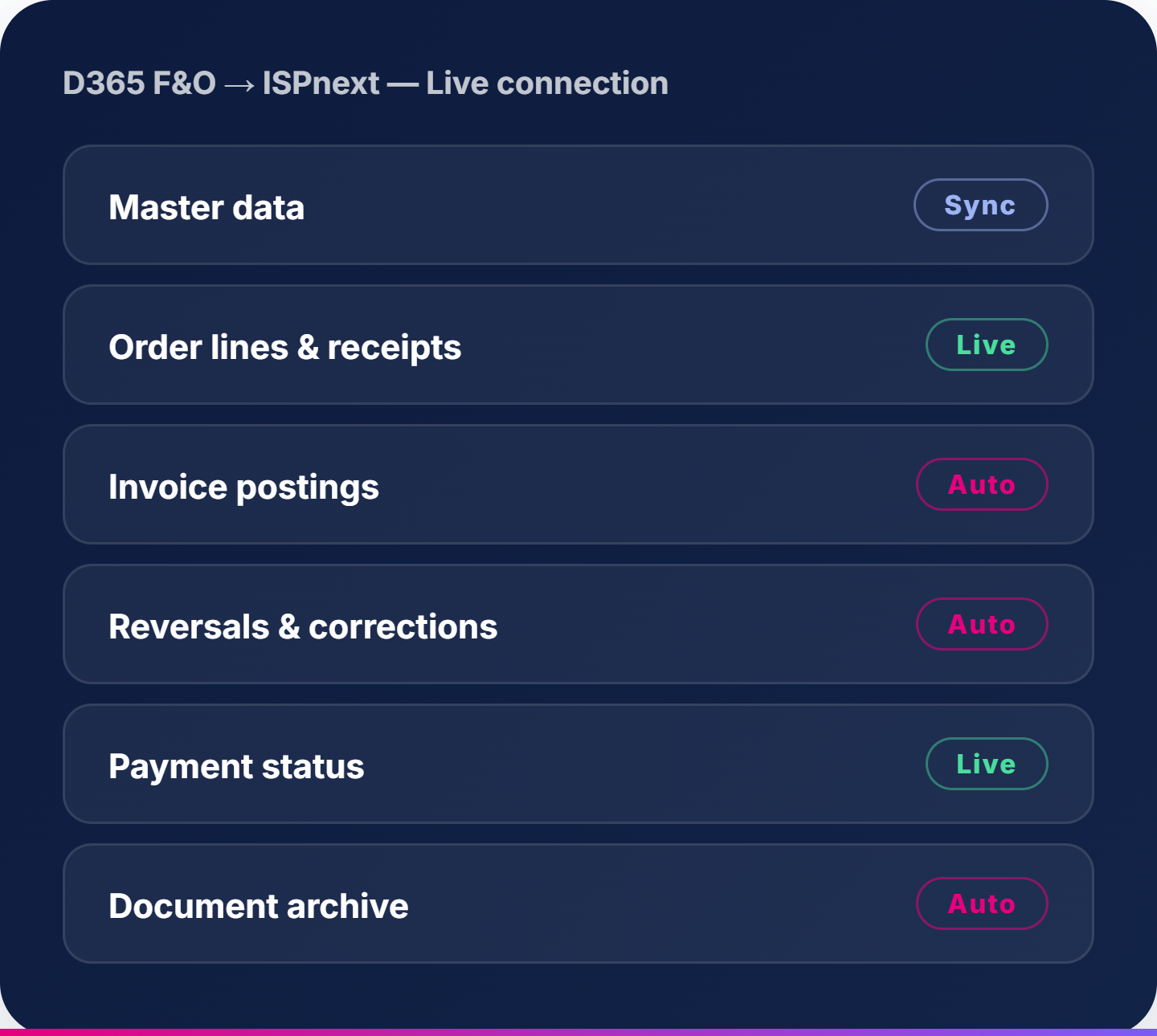
The integration between ISPnext and Microsoft D365 F&O uses D365 F&O APIs and OData services. D365 F&O remains the Single Source of Truth, while master data, transactions and process information are synchronised in real time for audit trails, matching and workflows.

The integration supports, among other things:

  • Full synchronisation of master data and transactions
  • Automated processing of order lines, receipts, invoices and postings
  • Automated invoice recognition and validation
  • 2-way and 3-way matching between PO, receipt and invoice
  • Full support for reversals and corrections
  • Feedback of payment date and status to D365 F&O
  • Support for G-account processes
  • Archiving and click-through functionality from D365 F&O to ISPnext

Which organisations benefit most from D365 Finance & Operations?

Icon_Financial services_2x

Finance teams with high invoice volumes

For organisations aiming to automate invoice processing, reduce manual entry and errors, and strengthen AP control.

Icon_Inzicht uitgaven

Procurementled organisations with complex approvals

Ideal for POdriven businesses that require receiptbased validation, exception routing and structured approvals.

Icon_Hogere compliance

Shared service centres needing compliance & control

Designed for teams that need strong audit trails, permission models, and endtoend visibility across entities.
Icon_AP automation_2x

AP Automation aligned with Microsoft Dynamics

Download the whitepaper and discover how to transform your AP process in Dynamics 365 today.

Mockup_Preview_Whitepaper_AP & MD365 (NL)

Frequently asked questions

What’s the difference between Dynamics 365 Finance and Dynamics 365 Finance & Operations (F&O)?

Finance focuses on core accounting; F&O covers finance plus supply chain and operations.

What data is synchronised in the D365 F&O integration?

Suppliers, master data, purchase orders, receipts, invoices, postings and payment statuses.

Is the integration realtime or batchbased?

Realtime by default, with support for hybrid scenarios when needed.

Do approvers need D365 licences to approve invoices?

Not necessarily; approvals can be handled in ISPnext without additional D365 licences.

Does it support 2way and 3way matching?

Yes, including exception analysis and routing.

How does it support compliance and auditability?

Comprehensive audit trails, workflow controls, permission management, and document access.

How long does implementation typically take?

Short timelines thanks to a standard connector and proven 5step approach.

Can it work with UK requirements (VAT and multientity setups)?

Yes, VAT processes and multicompany operations are fully supported.