<img src="https://secure.leadforensics.com/51974.png" style="display:none;">

Exact × ISPnext: real-time control over financial processes

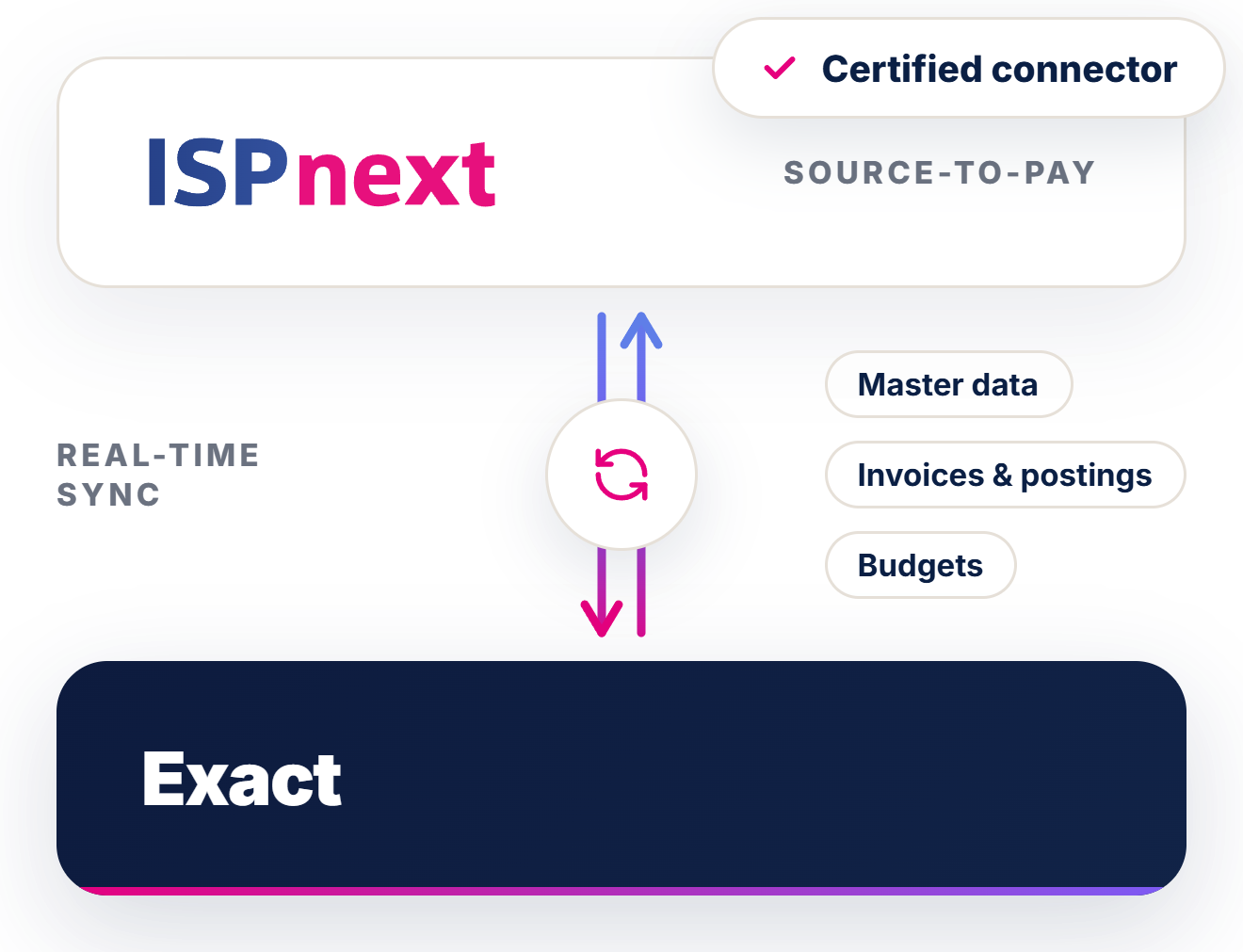
Exact is the financial foundation for many organizations. Yet the management of liabilities, invoices, approvals and expenses often remains fragmented. Combining Exact with ISPnext creates a single governance-driven Source-to-Pay process that focuses on real-time synchronization, control and auditability.

Exact is used to manage master data, financial entries, orders, receipts and reports. It is the system-of-record for financial integrity, but needs additional workflow structure to achieve full supply chain control.

PIPELINE-Exact-Online-logo-ERP-page

Exact × ISPnext in the Source-to-Pay process

Exact remains the source for master data and financial capture.
ISPnext takes care of digital governance: workflows, matching, approvals, file building, risk signaling and spend control.
Together this forms one controlled process from request to payment with real-time data consistency.

Icon_Time to Value_blue

Efficient invoice processing

Automatic matching of invoices with orders and receipts speeds up processing and reduces manual work.
Icon_Realtime insights_purple

Strong compliance and reduced risk

Uniform workflows and full auditability ensure better compliance and reduced risk.
Icon_Higher compliance_pink

Real-time insight into cash flow

Always up-to-date insight into liabilities and cash flow for better financial management.

Exact × ISPnext in practice

The link uses existing Exact data without duplicating processes. Finance and procurement work on the same reliable data in one controlled process.

1. Assessment

2. Connection

3. Master data

4. Automation

5. Control

Sage_Step 1

1. Process and data flow assessment

The first step defines which financial and operational processes are included in the Exact integration. This typically covers invoice processing, supplier data, financial postings, purchase orders and goods receipts. By clearly mapping these data flows upfront, organisations create a controlled foundation for automation and avoid fragmented processes or duplicate administration. From a governance perspective, this assessment is critical. It clarifies where approvals take place, which controls are required and where financial or compliance risks may arise. As a result, the integration supports a governed Source‑to‑Pay process rather than a purely technical connection.
Sage_Step 2

2. Connection via Exact Online APIs

The technical connection is established using the Exact Online APIs, enabling secure and reliable real‑time data exchange between Exact and ISPnext. Changes in Exact are immediately reflected in Source‑to‑Pay workflows, ensuring all decisions are based on up‑to‑date financial information. Because the integration relies on standard APIs, Exact remains the system‑of‑record for financial data. This reduces IT complexity, avoids custom development and limits operational risk when ERP updates or changes occur.
Sage_Step 3

3. Master data synchronisation

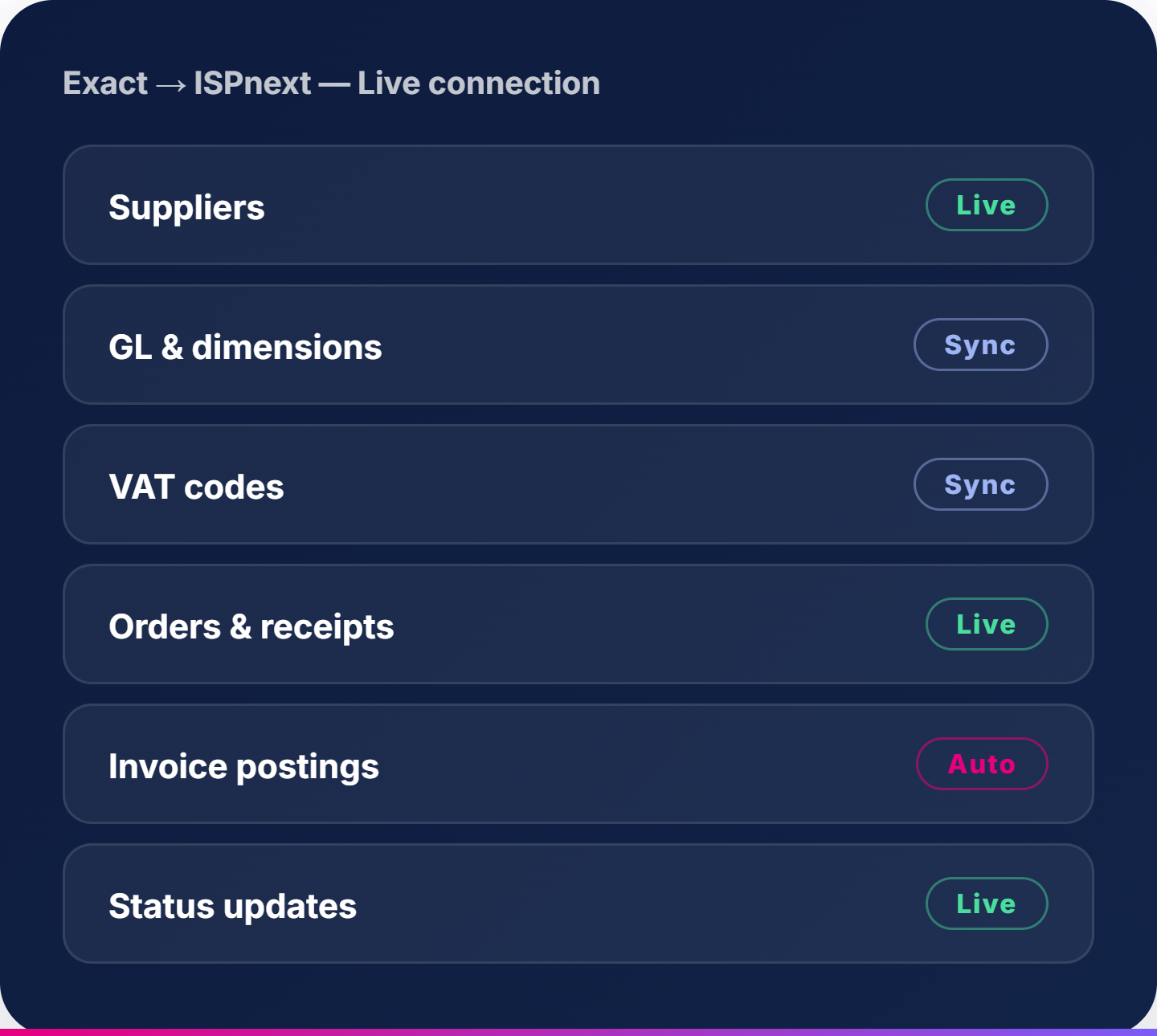
In this step, master data such as suppliers, general ledger accounts, VAT codes, financial dimensions and payment terms is synchronised in real time. This ensures that finance and procurement teams always work with consistent and current data. Reliable master data is essential for compliance and auditability. It prevents posting errors, reporting inconsistencies and unnecessary exceptions in approval flows, while forming the foundation for accurate matching and payment control.
Stockphoto_Mark

4. Automation of invoice processing and matching

The Exact integration enables automated invoice processing and matching based on purchase order and goods receipt data. Depending on the configuration, both 2‑way and 3‑way matching are supported. Deviations are identified early, so finance teams focus only on true exceptions. This significantly reduces manual workload and error risk while ensuring every invoice is supported by a complete, transparent process record. Each step, decision and control is documented as part of a fully traceable audit trail.
Stockphoto_Dirk Jan_Paul Johan

5. Control, archiving and go‑live

Before going live, the integration is validated for stability, error handling and payment control. This includes managing reversals, handling exceptions and ensuring complete and compliant archiving of financial documents. After go‑live, organisations operate a fully integrated process where Exact data, workflows and documentation come together. The result is demonstrable compliance, strong auditability and lasting control over financial processes, even as volumes and complexity increase.
Maarten de Ru ISPnext
"Exact provides the financial basis, but with ISPnext, the entire chain becomes predictable and controllable."

Maarten de Ru | Director Product, Partner & Solution Consulting

What roles and departments is Exact integration suitable for?

Tom CFO-1

CFOs

 Reliable figures and predictable cash flow.
Gain faster insight into commitments, expenditure and invoice flows. By connecting financial data from Exact with ISPnext, you gain greater control over budgets, liquidity and reporting.
 
Sarah CPO

CPOs

 Complete control over spend and process compliance.
Strengthen procurement with up-to-date spend data, approved suppliers and streamlined purchasing processes. This improves contract compliance, prevents maverick buying and keeps costs under control.
 
Alex IT Manager

Finance Operations / AP Managers

 Fewer exceptions, faster processing.
Automate invoice processing and reduce manual checks between ISPnext and Exact. As a result, invoices are processed faster, more consistently and with fewer errors.

 
Icon_AP automation_2x_cropped

AP Automation in 5 steps

Download the white paper ‘AP Automation in 5 Steps’ and gain valuable insights into how to cut costs, reduce errors and optimise your processes.

Mockup_Preview_AP Automation in 5 stappen (ENG)

Frequently asked questions about Exact & ISPnext

Will Exact remain the leading system?

Yes, Exact remains the system-of-record for master data and financial entries. ISPnext adds workflows, control and governance.

Do existing processes need to be modified?

No, the integration builds on existing Exact processes. ISPnext adds structure and automation without duplication of data.

How complex is the implementation?

Implementation is relatively quick because it uses existing data and standard links to Exact.

What happens when there are discrepancies in invoices or orders?

Deviations are automatically flagged and processed through workflows for quick and controlled handling.

For which organizations is this integration of particular interest?

For organizations working with Exact that want more control over their financial processes, compliance and spend.