

Peppol has become one of the most important networks for electronic invoicing across Europe. As organisations continue to digitise finance processes and prepare for evolving compliance requirements, Peppol is increasingly being adopted as the standard for secure and reliable invoice exchange.
What is Peppol?
Peppol is a standardised network that enables organisations to exchange electronic business documents, such as invoices and purchase orders, in a structured and secure format.
Why does it matter?
Peppol reduces complexity in electronic document exchange, improves interoperability between systems and supports the growing adoption of e-invoicing across Europe and beyond.
The key takeaway
Many organisations first encounter Peppol because of compliance requirements. In practice, the greatest benefits often come from improved automation, higher data quality and more efficient invoice processing.
Peppol provides the standardised infrastructure for exchanging structured invoice data. It does not replace the controls and workflows required to validate, match, approve, post and archive invoices. For finance teams, the strategic value emerges when Peppol e-invoicing is connected to AP Automation, ERP integration and the wider Source-to-Pay process.
What is Peppol?
Peppol stands for Pan-European Public Procurement Online.
Originally developed to simplify electronic procurement and invoicing within the public sector, Peppol has evolved into a widely adopted framework that enables both public and private organisations to exchange business documents securely and consistently.
Rather than sending invoices as email attachments or PDFs, organisations can exchange structured invoice data directly through the Peppol network. This ensures information can be processed automatically by financial systems without requiring manual interpretation or re-entry.
Today, Peppol supports a wide range of business documents, including:
- Electronic invoices
- Credit notes
- Purchase orders
- Order confirmations
- Shipping documents
As governments and businesses continue to embrace digital invoicing, Peppol has become an increasingly important building block of modern finance operations.
Why Peppol is becoming increasingly important
For many organisations, interest in Peppol starts with compliance.
Across Europe, governments are introducing new requirements around electronic invoicing, digital reporting and structured invoice exchange. Peppol is frequently used as the preferred network for meeting these requirements.
However, the benefits extend far beyond compliance.
When invoice information is exchanged in a structured format, organisations can:
Reduce manual processing
Improve invoice data accuracy
Accelerate approval workflows
Decrease processing costs
Improve auditability
Increase transparency
This is why many finance leaders no longer view Peppol purely as a compliance tool.
They increasingly see it as a foundation for more standardised, traceable and automated finance processes. For many organisations, the journey starts with electronic invoice exchange but quickly expands into workflow automation, AP efficiency improvements and finance process optimisation.
The value of this broader approach is not limited to processing speed. Structured data can also support more consistent controls, clearer process ownership and greater traceability throughout the invoice lifecycle.
How the Peppol network works
One of the reasons Peppol has been widely adopted is its simplicity.
Rather than requiring organisations to establish individual connections with every supplier or customer, Peppol creates a standardised network that allows participants to exchange documents in a consistent way.
Step 1: Sender
The sender creates an electronic invoice or another structured business document within its ERP, finance or invoicing system.
Step 2: Sender's Peppol Access Point
The document is transmitted through a certified Peppol Access Point. An Access Point acts as a secure gateway that connects organisations to the Peppol network.
Step 3: Peppol network
The network identifies the recipient and securely routes the document to the correct destination.
Step 4: Receiver's Peppol Service Provider
The receiving service provider receives the document and delivers it to the connected organisation.
Step 5: Receiver
The receiving organisation obtains the structured document through its connected system. Depending on the wider solution, the invoice can then move into validation, matching, approval, ERP posting and archiving processes.
This four-step model allows organisations to choose their own service provider while still exchanging standardised business documents with other Peppol-enabled organisations. It removes the need to create and maintain a separate connection for every trading relationship.
What Peppol does and does not do
Peppol standardises the secure exchange of electronic business documents between organisations. A Peppol Access Point connects the sender or receiver to the network and routes structured documents to the correct destination.
Peppol does not, by itself, manage the complete invoice processing lifecycle. Finance teams still require controls for invoice validation, purchase order matching, approval workflows, exception handling, ERP posting, reporting and digital archiving.
This distinction is important when comparing basic Peppol connectivity with broader e-invoicing and AP Automation solutions. Connectivity determines how structured documents are exchanged. Invoice automation determines how those documents are controlled and processed after they enter the organisation.
For enterprise organisations, both layers need to work together. Reliable invoice exchange must be connected to internal workflows, financial controls and the systems responsible for processing and recording the invoice.
Common misconceptions about Peppol
Although Peppol adoption continues to grow, several misconceptions still exist.
Peppol is only for governments
This was once largely true.
Today, Peppol is widely used by both public and private organisations across numerous industries.
Many businesses use Peppol to exchange invoices with suppliers, customers and government entities through a single network.
Peppol and e-invoicing are the same thing
Peppol and e-invoicing are closely related, but they are not the same. E-invoicing refers to the electronic exchange of structured invoice data.
Peppol is one of the networks used to facilitate that exchange.
An organisation can implement e-invoicing using Peppol, but e-invoicing itself is the broader concept.
Peppol automatically solves invoice processing
This is one of the most common misconceptions.
Peppol helps organisations exchange invoice data electronically, but it does not automatically optimise invoice processing workflows.
Organisations still need processes for:
- Validation
- Matching
- Approval
- Reporting
- Archiving
The greatest benefits are achieved when Peppol is combined with broader invoice automation initiatives.
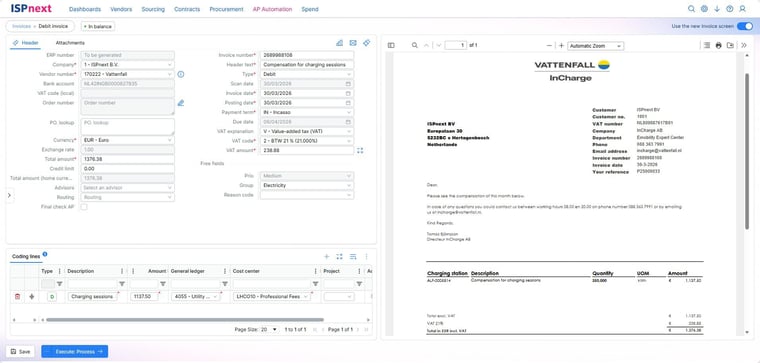
Receiving structured invoice data is therefore only the first step. AP Automation is needed to control how invoice data is validated, matched, approved, processed in the ERP system, reported and archived.
This is also where governance becomes important. Structured data must still be processed through clearly defined workflows, with appropriate controls and traceability across each stage of the invoice lifecycle.
Discover how AP Automation connects structured invoice exchange with validation, matching, approval workflows and ERP processing.
Peppol vs traditional invoice exchange
Many organisations still receive invoices as PDFs attached to emails. While this may appear digital, the process often requires significant manual intervention.
| Area | PDF by email | Peppol-based exchange |
|---|---|---|
| Data format | Usually unstructured or semi-structured | Structured and standardised |
| System processing | Often requires manual entry or recognition | Designed for machine-to-machine processing |
| Exchange method | Email-based document transfer | Exchange through the Peppol network |
| Data consistency | Depends on document layout and supplier input | Based on defined document standards |
| Automation potential | Dependent on capture and recognition tools | Supports automated validation and downstream processing |
| End-to-end invoice control | Requires additional workflows and systems | Also requires additional workflows and systems |
With Peppol, structured data is exchanged directly between systems, reducing the need for manual handling and improving consistency.
The key difference is not simply PDF versus digital invoicing. It is the difference between exchanging a document that still needs to be interpreted and exchanging structured data that systems can process consistently.
However, organisations still need workflow governance to control what happens after the invoice is received. Peppol can improve the quality and consistency of the incoming data, but processes for validation, matching, approval, exception handling and posting remain necessary.
A common mistake when adopting Peppol
Many organisations approach Peppol as a connectivity project.
The assumption is often: "Once we connect to Peppol, the work is done."
Connecting to the Peppol network enables structured invoice exchange, but it does not automatically establish the controls required across validation, matching, approvals, posting and archiving.
The exchange of structured invoice data creates the greatest value when it is connected to broader finance processes such as:
Invoice validation
Purchase order matching
Approval workflows
Digital archiving
Accounts Payable automation
Organisations that view Peppol purely as an IT initiative often realise only a fraction of its potential benefits.
A coordinated approach across finance, procurement and IT helps ensure that network connectivity, internal controls, ERP integration and invoice workflows are designed as one controlled process.
This reduces the risk of creating a technically connected environment in which invoice exceptions, approvals and manual interventions remain fragmented across different systems and teams.
Why Peppol matters for finance teams
The impact of Peppol extends beyond technical connectivity.
For CFOs
Structured invoice data can improve consistency, visibility and compliance readiness. To strengthen financial control, CFOs also need traceable validation, approvals, matching, posting and reporting across the invoice lifecycle.
Connecting Peppol with controlled invoice workflows can help Finance establish a clearer relationship between the invoice received, the checks performed and the final financial transaction.
For Finance Managers, Accounts Payable and Accounts Receivable teams
Peppol reduces dependence on invoice PDFs and manual data entry across both incoming and outgoing invoice flows. For Accounts Payable teams, structured invoice data can move through validation, matching, approval and archiving workflows with fewer manual handovers when Peppol is connected to invoice automation.
For Accounts Receivable teams, Peppol supports the structured and secure delivery of outgoing invoices to customers and public-sector organisations. This helps create a more consistent invoicing process, reduces reliance on email-based delivery and improves traceability from invoice creation to exchange.
By supporting invoices in both directions, Peppol can help finance teams create a more connected process across Accounts Payable and Accounts Receivable. The value still depends on how effectively the organisation integrates the exchange layer with ERP systems, internal controls and operational workflows.
For CPOs and procurement teams
Reliable invoice and purchase order data supports stronger control over supplier transactions. Connecting Peppol invoicing with procurement workflows also helps align invoices with orders, receipts and agreed processes.
This creates a clearer connection between procurement activity and the invoices ultimately processed by Finance.
For CIOs
Peppol introduces a standardised route for document exchange, but integration with ERP and financial systems remains essential. CIOs need a controlled architecture that connects external invoice exchange with internal workflows, data governance and audit requirements.
The distinction between connectivity and process automation is particularly important when evaluating a Peppol Access Point, an ERP module and a broader e-invoicing or AP Automation solution.
For COOs
Standardised invoice exchange can reduce operational fragmentation. The wider value comes from creating consistent workflows across finance, procurement and business operations.
This supports clearer process ownership and reduces dependence on disconnected handovers between systems, functions and operational teams.
Peppol as part of wider finance transformation
Electronic invoicing is becoming increasingly connected to wider business objectives.
Organisations are using structured invoice data to support:
- Accounts Payable automation
- Compliance readiness
- Financial reporting
- Supplier collaboration
- Process optimisation
As a result, the distinction between invoice exchange and invoice automation is becoming less clear.
Finance leaders are increasingly looking for solutions that combine:
- E-invoicing
- Workflow automation
- ERP integration
- Financial visibility
- Compliance support
This broader perspective shifts the focus from invoice transmission alone to controlled invoice processing, reliable data and stronger financial governance.
It also helps decision-makers distinguish between basic automation and a connected approach. An ERP module may support financial processing, while a Peppol Access Point supports network connectivity. AP Automation governs the operational invoice workflow, and Source-to-Pay connects that workflow to the wider procurement and supplier process.
The strategic consideration is therefore not only which system can receive an electronic invoice. It is how the organisation creates a traceable process from external document exchange to internal validation, approval, accounting and archiving.
Connecting Peppol to the wider Source-to-Pay process
Peppol solves the exchange of structured business documents. ISPnext connects e-invoicing with the processes that determine how invoices are validated, matched, approved, posted, reported and archived.
By bringing Peppol e-invoicing, AP Automation, ERP integration and Source-to-Pay processes together, finance and procurement teams can work with more consistent data, controlled workflows and a traceable invoice lifecycle.
This moves the conversation beyond connectivity towards financial control, auditability and operational efficiency. It also creates a clearer distinction between receiving structured invoice data and governing the complete process around that data.
Within a Source-to-Pay approach, invoice processing does not stand alone. It can be connected to purchase orders, supplier information, approvals and the financial systems in which transactions are recorded. This gives Finance and Procurement a shared process context without suggesting that Peppol itself manages every stage.
For organisations evaluating different solution types, this distinction is essential:
- A Peppol Access Point provides access to the e-invoicing network.
- An ERP system supports financial administration and posting.
- AP Automation manages validation, matching, approvals, exceptions and archiving.
- A Source-to-Pay approach connects invoice processing with the wider procurement and supplier lifecycle.
The appropriate solution scope therefore depends on whether the organisation only needs connectivity or also needs control over the complete invoice process.
The role of Peppol in the future of e-invoicing
As electronic invoicing requirements continue to develop, organisations need an approach that can support structured document exchange across different systems and business relationships. Peppol provides a standardised framework for that exchange.
For finance teams, the longer-term consideration is not only how invoices enter the organisation, but how structured data is governed throughout validation, matching, approval, posting, reporting and archiving.
Peppol is therefore most valuable when it forms part of a connected invoice processing and Source-to-Pay strategy. In this context, the Peppol network provides the exchange layer, while internal systems and workflows provide process control, auditability and operational governance.
This connected perspective enables organisations to prepare for wider adoption of electronic invoicing without treating compliance, connectivity and automation as separate initiatives.
Frequently asked questions
Looking to simplify e-invoicing and invoice automation?
Discover how organisations connect Peppol, e-invoicing, AP Automation and Source-to-Pay processes to improve compliance, efficiency and visibility.