

France is introducing mandatory e-invoicing and e-reporting requirements that will impact every VAT-registered organisation operating in the country. From September 2026, all businesses must be able to receive electronic invoices, while larger organisations must also start issuing them. Smaller businesses will follow in September 2027. The reform is designed to improve VAT reporting, increase transparency and accelerate the digitalisation of financial processes.
The deadline
The first phase begins on 1 September 2026. All organisations must be capable of receiving electronic invoices from that date. Large enterprises and medium-sized organisations must also begin issuing electronic invoices, while SMEs and micro-businesses follow in September 2027.
The impact
The reform affects much more than invoice exchange. Finance teams must review their invoice workflows, ERP integrations, supplier data and reporting capabilities to ensure compliance. Expectations around auditability, data accuracy and financial control increase as well.
The opportunity
Businesses that combine compliance initiatives with AP Automation and Source-to-Pay transformation can create faster, more efficient and more controlled financial processes while reducing compliance risk and improving governance.
For many organisations, the first reaction is to view the mandate as another compliance obligation. However, organisations that take a strategic approach can use the transition to strengthen governance, modernise Accounts Payable processes and gain greater visibility across the entire Source-to-Pay lifecycle.
Why France is introducing mandatory e-invoicing
Across Europe, governments are investing heavily in the digitalisation of tax administration. France is one of the largest economies to implement a comprehensive electronic invoicing framework, following similar initiatives in countries such as Italy and Poland.
The French government has several objectives:
Improving VAT collection
Reducing tax fraud
Increasing transaction transparency
Simplifying reporting processes
Accelerating digital business operations
Increased transparency and fraud prevention
One of the primary drivers behind France’s e-invoicing reform is the reduction of VAT fraud and invoice-related errors. In traditional invoice processes, paper documents and PDF invoices can be difficult to validate and track, creating opportunities for duplicate invoices, altered information or inaccurate reporting.
With structured electronic invoices and mandatory reporting requirements, invoice data becomes significantly more transparent and traceable throughout the entire process. Every transaction is recorded digitally, making it easier for both businesses and tax authorities to identify discrepancies, validate information and maintain accurate records.
While no system can completely eliminate fraud, the French model significantly reduces opportunities for invoice manipulation and reporting inconsistencies. At the same time, organisations benefit from stronger financial controls, improved auditability and greater confidence in the accuracy of their financial data.
To achieve this, invoices must move from static documents towards structured digital data that can be processed automatically.
Traditional PDF invoices often require manual intervention. Data must be entered, checked and matched before payment can take place. Structured electronic invoices enable systems to perform these activities automatically, improving efficiency and reducing processing errors.
For organisations already pursuing digital transformation initiatives, the reform aligns naturally with broader objectives around automation, process standardisation and operational excellence.
What exactly is changing?
Under the French framework, domestic business-to-business invoices must be exchanged electronically using approved structured formats. France supports formats including:
- Factur-X
- UBL
- CII
These formats allow invoice data to be processed automatically without manual rekeying of information.
In addition, invoice information and transaction data must be exchanged through approved electronic invoicing platforms. The objective is to provide tax authorities with more accurate and timely information while creating a standardised invoicing ecosystem across the country.
The role of approved platforms (Plateforme Agréée)
A key element of the French e-invoicing framework is the use of approved electronic invoicing platforms, known as Plateformes Agréées (previously referred to as PDPs, Plateformes de Dématérialisation Partenaires).
These government-approved platforms are responsible for securely routing electronic invoices between suppliers and buyers while transmitting the required invoice and reporting data to the French tax authorities. Rather than exchanging invoices directly via email, organisations must use an approved platform that complies with the technical and regulatory requirements of the French mandate.
For businesses operating in France, selecting the right platform partner will be an important part of their compliance strategy. Organisations should evaluate how approved platforms integrate with existing ERP, procurement and Accounts Payable systems to ensure a seamless invoice processing experience.
For many businesses, compliance goes beyond supporting new invoice formats or connecting to an approved platform. The transition often requires updates to financial systems, purchasing processes and supplier communication strategies. Many organisations are using France’s e-invoicing reform as a catalyst for broader Source-to-Pay optimisation and financial process automation. By combining compliance initiatives with process improvement programmes, businesses can create long-term value beyond regulatory readiness.
Key dates businesses should know
The rollout takes place in phases.
1 September 2026
From this date:
- All businesses must be able to receive e-invoices.
- Large enterprises must issue e-invoices.
- Medium-sized organisations (ETIs) must issue e-invoices.
- E-reporting requirements begin for applicable organisations.
1 September 2027
From this date:
- SMEs must issue e-invoices.
- Micro-businesses must issue e-invoices.
- Full implementation of the reform is achieved.
While 2027 may seem distant for smaller organisations, preparation often takes longer than expected. Supplier onboarding, process redesign and technology upgrades can require significant planning and coordination.
The organisations that start preparing now will face less pressure as deadlines approach.
Understanding the difference between e-invoicing and e-reporting
One of the most important aspects of the French reform is understanding that e-invoicing and e-reporting are not the same thing.
E-invoicing
E-invoicing applies to domestic B2B transactions between VAT-registered businesses established in France. Invoice data is exchanged electronically using approved formats and platforms.
E-reporting
E-reporting applies to activities outside the domestic B2B scope, including:
- Cross-border transactions
- Certain B2C activities
- Specific payment reporting obligations
Relevant transaction data must be reported electronically to French tax authorities.
For many organisations this creates an additional layer of complexity. Compliance requires both accurate invoice processing and consistent reporting procedures.
The impact on finance teams
Although the reform is often discussed as a compliance topic, its operational impact is far broader. Finance departments must ensure that invoice information can flow smoothly from receipt through approval, matching, payment and reporting.
Common challenges include:
- Multiple invoice formats
- Manual approval workflows
- Incomplete supplier information
- Inconsistent coding structures
- ERP integration challenges
- Audit and reporting requirements
Organisations relying heavily on spreadsheets, email approvals and manual processing may face increased compliance risk as requirements become more structured.
The reform highlights the growing need for digital workflows that support both efficiency and control. As compliance requirements become more sophisticated, organisations must balance operational efficiency with governance. Finance leaders increasingly need end-to-end visibility into invoice flows, approval decisions and reporting activities to reduce risk and maintain control.
Why data quality becomes more important
Electronic invoicing relies on structured data. If supplier information is incomplete or inaccurate, invoice processing errors become more likely.
Many organisations discover that they have:
- Duplicate suppliers
- Missing VAT information
- Outdated supplier records
- Inconsistent master data
As invoice exchanges become increasingly automated, poor data quality creates a larger operational and compliance risk. This is one reason many organisations are combining e-invoicing projects with supplier management initiatives.
Strong supplier governance creates the foundation required for successful digital invoice processing. Beyond operational efficiency, high-quality supplier and invoice data supports accurate reporting, stronger compliance controls and more reliable financial decision-making. As electronic invoicing becomes mandatory, data quality becomes a critical element of both governance and risk management.
Why AP Automation becomes essential
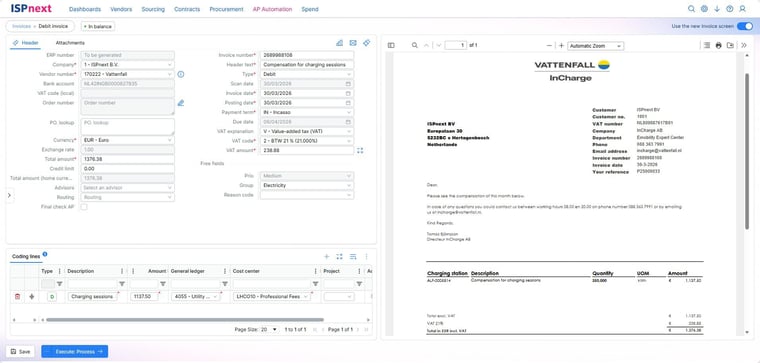
The move towards electronic invoicing is accelerating a trend that has been developing for years. As invoice data becomes increasingly structured, organisations also need structured controls around validation, approvals, matching and reporting. Manual Accounts Payable processes are becoming increasingly difficult to scale while maintaining compliance and auditability.
With AP Automation, organisations can:
Capture invoices automatically
Validate data more accurately
Route approvals digitally
Match invoices against purchase orders
Reduce processing delays
Improve compliance monitoring
Strengthen audit trails
The benefits extend beyond compliance. Faster invoice processing improves supplier relationships. Better visibility supports cash flow management. Reduced manual interventions free finance professionals to focus on higher-value work.
When implemented effectively, AP Automation reduces manual effort, improves oversight and enables finance teams to focus more on control, risk management and financial insight.
From compliance to Source-to-Pay excellence
Organisations can reduce implementation and governance gaps by treating e-invoicing as part of the wider Source-to-Pay process rather than as an isolated finance project. When supplier, contract, procurement and invoice data operate in separate systems, compliance efforts often remain fragmented. A unified Source-to-Pay approach creates a single foundation for control, visibility and regulatory readiness.
A connected Source-to-Pay approach provides:
Better spend visibility
Improved supplier collaboration
More accurate contract compliance
Stronger financial governance
Reduced operational risk
Higher process efficiency
Invoice data becomes far more valuable when connected to purchasing, supplier management and contract information. The result is not just regulatory compliance but improved decision-making throughout the organisation.
What this means for CFOs, CPOs and CIOs
For CFOs
The reform provides an opportunity to improve financial control, reporting quality and compliance readiness. Automation can help increase accuracy while providing greater visibility into liabilities and cash flow.
For CPOs
Procurement leaders benefit from improved supplier transparency and stronger process governance. More accurate data supports better purchasing decisions and improved supplier performance management.
For CIOs
Technology leaders must ensure systems, integrations and digital processes are capable of supporting the new requirements. For CIOs, the mandate is not only about compliance. It is an opportunity to reduce system fragmentation, improve data consistency and establish a scalable digital foundation for future European e-invoicing initiatives.
Investments made today can support future compliance initiatives across Europe and create a more scalable digital foundation.
How ISPnext helps
Compliance is only one part of the challenge. Organisations also need visibility, process control and reliable data across the full Source-to-Pay lifecycle. As regulatory requirements increase, businesses need a connected approach that supports governance, risk management and operational efficiency simultaneously.
ISPnext helps organisations digitise and optimise procurement and finance processes through a single AI-powered Source-to-Pay platform. With integrated solutions for AP Automation, procurement, vendor management and contract management, organisations can:
Improve compliance readiness
Increase processing efficiency
Enhance spend visibility
Strengthen supplier governance
Reduce operational risks
Improve financial control
Rather than implementing disconnected tools, organisations can create a future-proof environment that supports both compliance and business growth.
Final thoughts
France’s e-invoicing mandate is not simply a regulatory milestone. It is another step towards the digital future of finance and procurement.
Organisations that postpone preparation may find themselves focused solely on compliance. Those that act early have the opportunity to gain much more. By combining e-invoicing readiness with AP Automation, supplier governance and Source-to-Pay optimisation, organisations can transform a compliance requirement into a strategic advantage.
The organisations that gain the greatest value from France’s e-invoicing reform will be those that treat compliance as a catalyst for stronger governance, better visibility and more intelligent Source-to-Pay operations. By acting early, organisations can improve efficiency, strengthen financial control and create lasting business value.