

Automate your invoice processing with AI and experience an error rate drop from 20% to 2%, leading to a productivity increase of 20-30%.
Faster processing
AI functionality speeds up the processing of incoming invoices.
Alongside e-invoicing
AI complements e-invoicing for the flow of invoices that does not yet arrive standardised.
Safe with your own data
Data security is a starting point in the use of the AI functionality.
To speed up the invoice processing process, we have added AI functionalities to our Source-to-Pay platform. "It brings more than we had dared to dream, both in efficiency and application possibilities. It's really spectacular."
AI takes invoice processing to next level
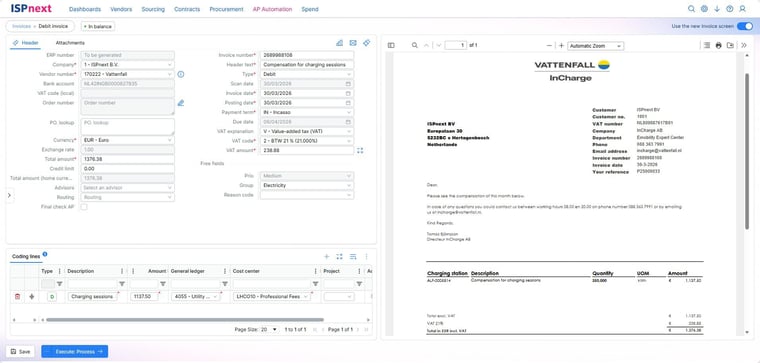
Almost every AP department is currently looking at deploying AI in invoice processing. This was recently confirmed in market research by Ardent Partners (“Accounts Payable 2025”). At the request of and in consultation with customers, we have started looking for solutions. It led to the development, in-house, of an AI functionality for initially smart document recognition. The tool automatically extracts invoice data from PDFs and scans.
Tests show that this reduces the error rate from 20% to 2%. "One consequence is that correction of invoices is needed less often. And subsequently, less checking is also necessary. This significantly increases the productivity of accounts payable. The first results indicate an increase of 20% to 30%," says John Schouten, Director Product Management.
Smarter invoice processing with nextAI
Check out the whitepaper "S marter i nvoice p rocessing with nextAI " and find out how you can use smart document recognition and self-learning technology to speed up your processes, minimise errors and save costs. Download the whitepaper!
But what about e-invoicing?
Does it make sense to invest in this when we will soon all be required to work with e-invoicing based on an XML standard? "I have been asked that question more often recently," says Schouten. "My first answer to that is that introduction of standardised e-invoicing is not going as fast as thought. Yes, it is now mandatory in Germany and in Belgium from 2026, but the Netherlands has not yet set a date. That could take years. Judging from the European directive ViDA, 1 July 2030 might be a date for mandatory e-invoicing across the EU. But that would mean at least five more years of inefficiency."
Advancement opportunities
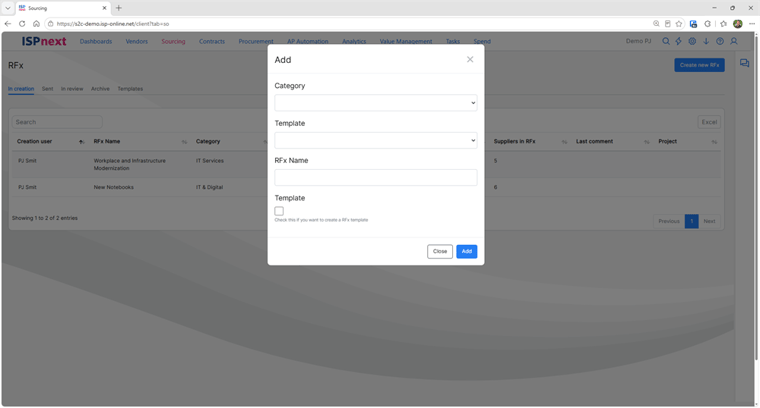
A third argument is that the technique can also be used for other parts of a Source-to-Pay platform. For instance, we are also going to apply the technique to quotes and contracts. "AI recognises all data points in a quotation, such as the supplier, document number, amount and so on. The system converts that data into a purchase order, without anyone having to retype anything. We eliminate errors. The same goes for contracts. Those are documents of up to 80 pages sometimes. Our AI technology converts relevant parts into a single purchase order. All you have to do is check and accept those."
A next step is a handy summary of the contract. "The system can additionally warn of risks within a contract," he says. Detecting invoice fraud was already among the possibilities.
“Many of our customers operate internationally. Because e-invoicing is not the standard everywhere, there will always be PDF invoices. Those are the ones you want to process as efficiently as possible.”
 John SchoutenDirector Product Management | ISPnext
Customer benefits
Automatic invoice recognition had been possible within our platform for some time. "But based on templates. This way, fixed elements of an invoice were recognised. Those templates required a lot of maintenance. That's a thing of the past, saving customers two to four hours of work per week. We now work with a central set of prompts, which is 99% sufficient. Sometimes a customer requires additional prompts, but the system has a strong self-learning capability."
Among other things, the prompts ensure that not only the invoice header is recognised but also all invoice lines. Moreover, the new functionality can handle all languages, not just Western languages. Schouten: "Invoice recognition speeds up and improves, from 80% to 98% completely good recognition. Fewer errors means less correction and checking. Almost error-free recognition increases productivity, by tens of percent. That capacity can be used in other areas within Finance and add more value there than repetitive, administrative work."
Data security
So we also apply AI technology to other components within our Source-to-Pay platform. "We offer it. Go and use it, I would advise." Schouten knows from experience that financials are reluctant to use new technology. "They are critical and highly value security. That is an additional plus of this technology: we have developed it ourselves. We don't work with third parties. All data stays within our platform and there they are guaranteed to be safe."
This article was produced in collaboration with CMweb.
Frequently asked questions
AI recognises and interprets invoice data, so less manual entry and checking is needed.
No. E-invoicing remains the standard for structured invoices; AI mainly helps with the invoices that do not yet meet that standard.
Data security is a precondition for using this functionality and is part of how the platform is set up.