
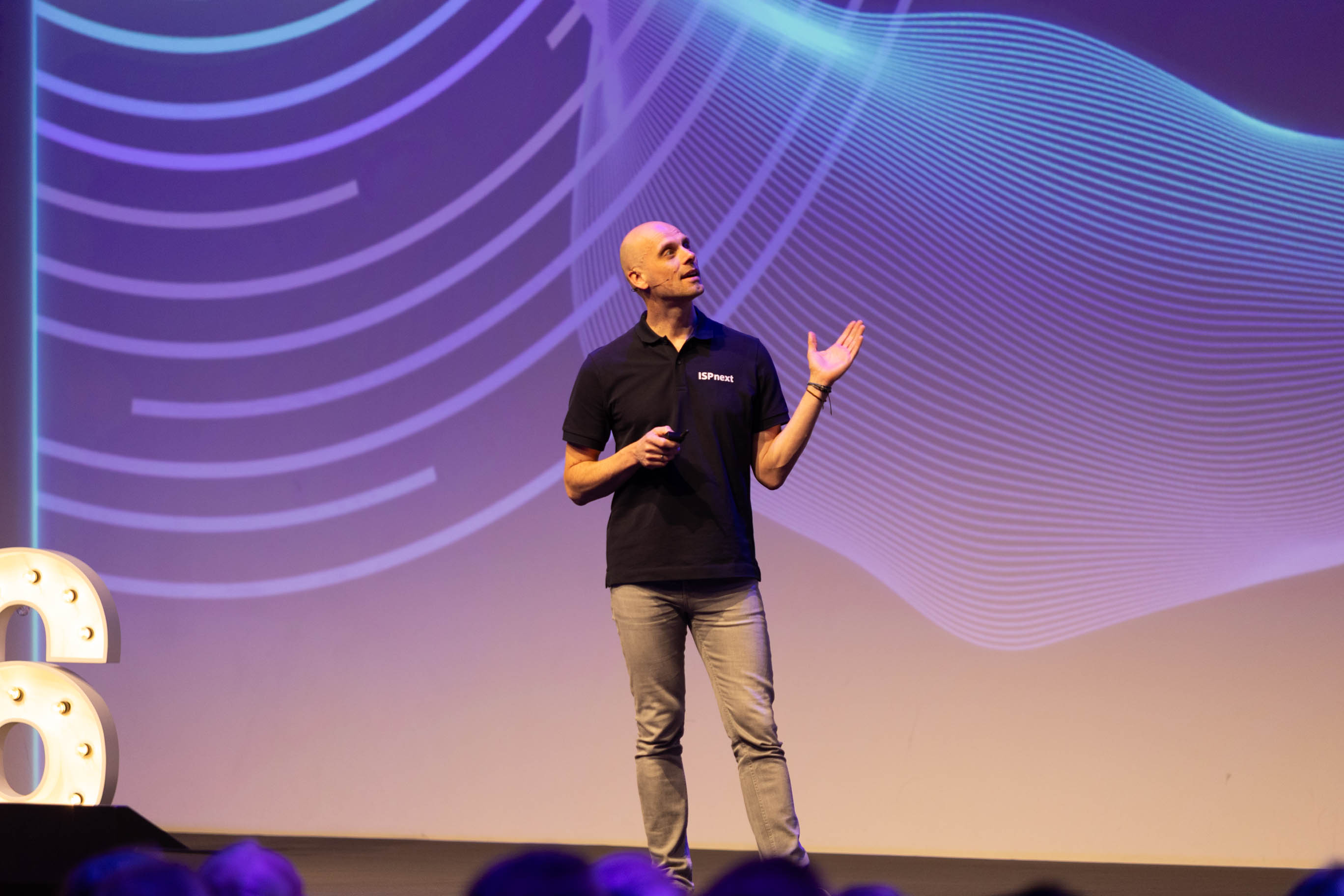
Discover how AI-driven automation streamlines finance and procurement processes, reduces manual work and improves control, compliance and efficiency.
Euros per invoice
The saving sits in less correction, less checking and shorter lead time.
Touchless processing
A large share of invoices moves through without intervention.
Own technology
The data stays inside the platform instead of with third parties.
This blog post was created in collaboration with CMweb.
On many Finance departments, workloads are high. Technology makes it possible to handle more work. With that in mind, ISPnext added a new dimension to its Source-to-Pay platform in 2025: nextAI. The AI agents are now becoming increasingly widely applicable. What started with invoice recognition is evolving into fully automated processes.
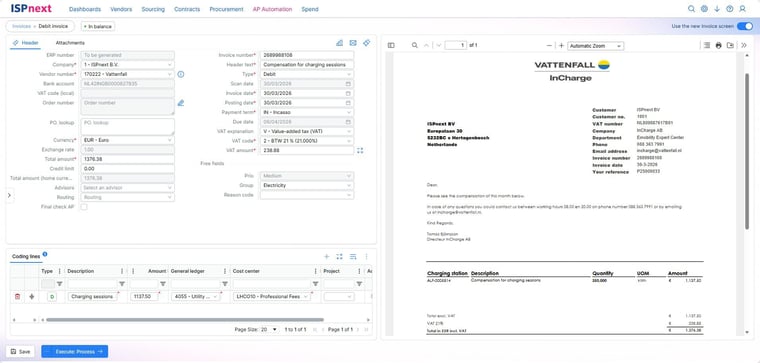
“nextAI was initially developed to automatically extract invoice data from PDFs and scans”, says John Schouten, Director Product Management at ISPnext. The tool ensures that people no longer need to manually input data. This leads to faster processing and fewer errors, which in turn results in less correction and control.
Savings per invoice
Schouten is able to translate the time and cost savings mainly labour costs into concrete figures. “On average, processing an invoice costs more than ten euros per invoice. Invoice recognition with nextAI is successful in more than 90% of cases. In practice, we see savings of at least two euros per invoice and in some cases up to six euros per invoice. Considering that we process tens of millions of invoices annually, the savings potential is significant.”
Whitepaper: Smarter invoice processing with nextAI
With Artificial Intelligence (AI) in both AP Automation and Contract Management, you take the next step towards an automated, reliable, and efficient process for processing both invoices and contracts. Less manual work, greater control over your invoices and contracts, and more time for the work that matters.
Fully touchless
Invoice processing can be divided into three steps (1) receipt and recognition, (2) matching and coding and (3) processing in ERP. “For the first part, we provide a central set of prompts. Customers can enrich these themselves. Traditional and maintenance heavy templates are therefore disappearing.”
In step two, the focus is mainly on coding invoice elements, assigning them to cost centres and communication with suppliers. “The correct coding is determined using algorithms, which are partly based on historical data and the data on the invoice”, Schouten explains. “At some customers, more than 80% of invoices are already processed fully touchless.”
Reading quotations and contracts
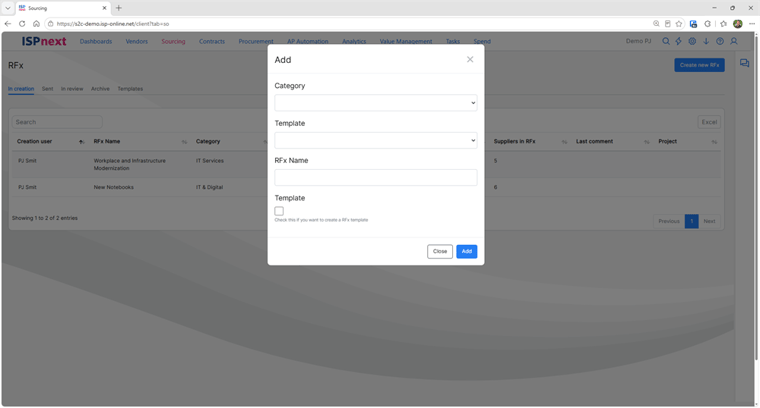
ISPnext now also applies AI agents to extract data from quotations and contracts. “We have invested a lot of development time in nextAI for AP Automation”, Schouten explains. “Adapting the prompts towards quotations and contracts was therefore relatively straightforward.”
All data points in a quotation such as supplier, document number and amount are converted by nextAI into a purchase order. The same applies to contracts, documents that can be up to 80 pages long. The tool can create a summary of the contract and convert relevant elements into a purchase order.
“The system indicates where the contract deviates from the procurement conditions and during a contract renewal the differences are shown compared to the previous contract”
“You only need to review and approve it. The system also indicates where the contract deviates from your procurement conditions and during a contract renewal the differences are shown compared to the previous contract. All of this saves many working hours.”
“In practice, we’ve found that the saving is at least two euros per invoice, and in some cases as much as six euros per invoice.”
 John SchoutenDirector Product Management | ISPnext
Security above all
Users of the ISPnext Source-to-Pay platform can define the boundaries within which the system is allowed to operate autonomously. “We make visible how decisions of nextAI are made”, says Schouten. The AI tool also helps detect fraud.
“Our software recognises patterns and deviations, which must be assessed by the administration”
He emphasises that nextAI has been developed in-house and only runs on the ISPnext platform. LLM models such as those from OpenAI are used to process documents in all languages. “But customer data is not used to train such models.”
“Security always comes first. Security is more important to us than additional features”, he states clearly. “There is no exchange of data with third parties. Our platform operates fully within EU data boundaries. To underline this governance, we are working on certification of nextAI with ISO 42001.”
AI is not a silver bullet
Finally, Schouten places the use of AI in the broader context of the Source to Pay process. “AI delivers spectacular benefits, absolutely. But real value arises when AI is embedded in a well structured process. This goes beyond financial administration. It starts earlier, with onboarding suppliers, working with contracts and purchase orders. The quality of data is decisive for optimal technological support. This requires strong collaboration with colleagues as well as strong partnerships with suppliers, who also benefit from fast and predictable invoice processing.”
“Real value arises when AI is embedded in a well structured process. This goes beyond financial administration”
He calls invoice processing the final stage. “It is the financial completion of the entire procurement process. Everything that is not properly organised earlier in the process ultimately returns on the invoice. That is why our role is increasingly shifting towards intelligence for structural improvements of the entire Source to Pay process.”