
QR code invoices Switzerland are mandatory since 2022. Find out the rules, benefits and new requirements for organisations.
Mandatory
The QR invoice has been the payment standard in Switzerland since 2022.
What it is
All payment details sit machine-readable in one code on the invoice.
In practice
Granovit processes QR invoices fully automatically.
"The QR-bill has been mandatory in Switzerland since 1 October 2022 and has completely replaced the previous red and orange payment slips," says Jochen Werner, Chief Revenue Officer at ISPnext. "This means that a Swiss QR code must be included on all invoices that are issued in Switzerland and are intended to trigger a payment. This QR code contains all the information required for the payment such as IBAN, amount, currency, name and address of the payee and other optional details."
Who is subject to the obligation?
- Organisations based in Switzerland: They are obliged to issue invoices with a Swiss QR code if the invoice triggers a payment and a Swiss or Liechtenstein bank account (IBAN beginning with CH or LI) is used.
- Invoices to Swiss recipients: Foreign organisations that issue invoices to Swiss organisations or private individuals must also ensure that they can receive and process QR-bills.
- Private individuals: The obligation primarily concerns organisations, not private payment transactions.
AP Automation in 5 steps
Discover how to automate invoice processing, across borders too.

What is a QR-invoice?
"The QR-invoice is a modern form of payment request," Werner explains. "It consists of a payment part and a receipt on which a Swiss QR code is printed. This code can be read with banking apps, smartphones or special scanners and enables simple, fast and error-free transfer of all payment data to e-banking or accounting software."
Advantages of the QR-invoice
- Efficiency: No more manual typing of payment data, which reduces errors and saves time.
- Standardisation: Uniform payment processing for CHF and EUR.
- Compatibility: QR-bills can be processed both digitally and on paper.
- Automation: Simplifies payment reconciliation and accounting.
Transitional regulations and new requirements
"The QR-bill has been mandatory since October 2022. From 21 November 2025, additional technical requirements will come into force, such as the obligation to use structured addresses in the QR code. Organisations must adapt their systems accordingly by then," says Jochen.
"In Switzerland, the QR code on invoices that trigger a payment is mandatory for companies. The QR-bill is now the standard in Swiss payment transactions and considerably simplifies both the issuing and payment of invoices."
“Thanks to the integration with ISPnext, Granovit processes QR invoices faster and fully digitally.”
 Jochen WernerChief Revenue Officer | ISPnext
Successful integration of the QR code function into AP Automation with ISPnext
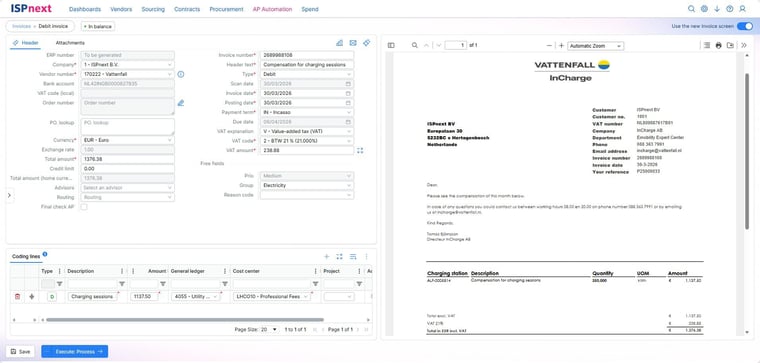
"ISPnext recognised the legal requirements for QR invoices at an early stage and fully integrated the functionality for processing Swiss QR codes into its AP Automation solution," Werner notes. "ISPnext thus enables organisations to digitise and process all invoices efficiently and in compliance with the law and to automate the payment process. Using ISPnext's powerful API, relevant master data and invoice information can be transferred directly from ERP systems so that the entire invoice workflow, from capture to payment, is seamless and error-free."
Best practice at Granovit
"A current example of the successful implementation of this solution is our customer Granovit in Switzerland. There, the integration of QR code functionality into AP Automation was successfully realised with ISPnext. Granovit now benefits from fully digitalised invoice processing, which not only meets legal requirements but also significantly increases efficiency and transparency in payment transactions. The automated processing of QR invoices ensures faster processing times, fewer errors and a noticeable reduction in the workload of the accounting department."
Frequently asked questions
If an invoice in Switzerland does not contain a QR code, the recipient may have difficulty processing and paying the invoice. Moreover, the organisation then fails to comply with legislation, which can lead to delays in payments and possible fines or penalties.
No, QR invoices are suitable for both Swiss francs (CHF) and euros (EUR). The standard supports both currencies, ensuring uniform processing within the Swiss payment system.
Yes, as long as the invoice gives rise to a payment and a Swiss or Liechtenstein bank account is used, the obligation applies. There is no exception based on the size or nature of the organisation.
Organisations would do well to check and update their ERP and invoicing systems in good time. In doing so, it is important to check whether structured addresses are processed correctly and whether all QR code fields are filled according to the new specifications.