

E-invoicing will soon be required for UK government suppliers. Learn what e-invoicing is, how it works, the benefits, and how to get started today.
More than a PDF
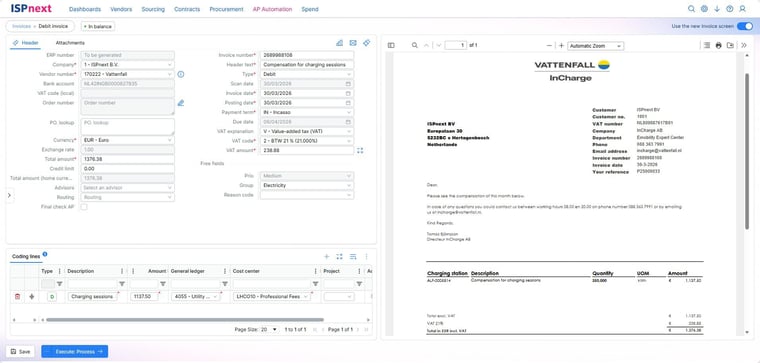
An e-invoice is a structured file that systems can read by themselves.
Becoming mandatory
More countries are making electronic invoicing compulsory, each on its own date.
Fewer errors
Without retyping, most input errors disappear from the process.
The days of manual invoice processing, separate PDF attachments, and time-consuming administrative checks are coming to an end. Electronic invoicing, or e-invoicing, is rapidly becoming the standard across Europe and the United Kingdom. This change is not only driven by efficiency and cost reduction, but also by evolving legislation. The shift towards e-invoicing reflects the broader trend of digital transformation in financial administration.
“E-invoicing is the catalyst for modern financial management. Organisations that invest now are building scalable and future-ready finance operations,” says John Schouten, Director of Product Management at ISPnext.
In this article, we explain what e-invoicing is, why it is becoming a legal requirement, the benefits it brings, and how your organisation can make the transition smoothly.
What is e-invoicing and how does it work?
E-invoicing refers to sending and receiving invoices in a structured digital format that can be processed automatically by accounting systems. Unlike PDF or paper invoices, an e-invoice contains data in a standardised format such as XML or UBL (Universal Business Language). This removes the need for manual entry and greatly reduces the risk of errors.
A key part of this process is the use of secure digital networks such as Peppol, which enable safe and reliable exchange of electronic invoices between businesses and public bodies. This increases data accuracy and reduces the likelihood of fraud or delays.
A true e-invoice is not a scanned document or a PDF containing embedded data. It is structured information that can be read and processed directly by financial software. This represents a fundamental shift in how organisations manage and control their financial operations.
Although many organisations today process invoices digitally in PDF format, this is often only an intermediate step in the digitalisation journey. OCR recognition and line-item matching remain prone to errors and still require manual checks. True efficiency is only achieved when using electronic invoices in formats such as XML or EDI, where invoice data is exchanged directly between systems. This eliminates the risk of interpretation errors and fully automates the invoice-processing workflow. A step that truly unlocks the potential of digitalisation.
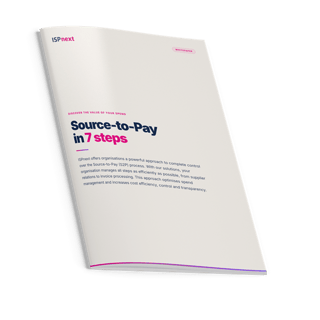
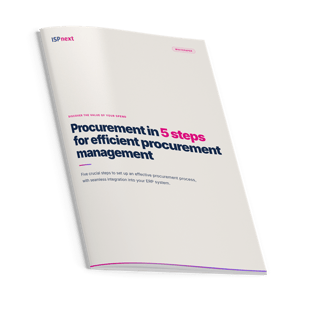
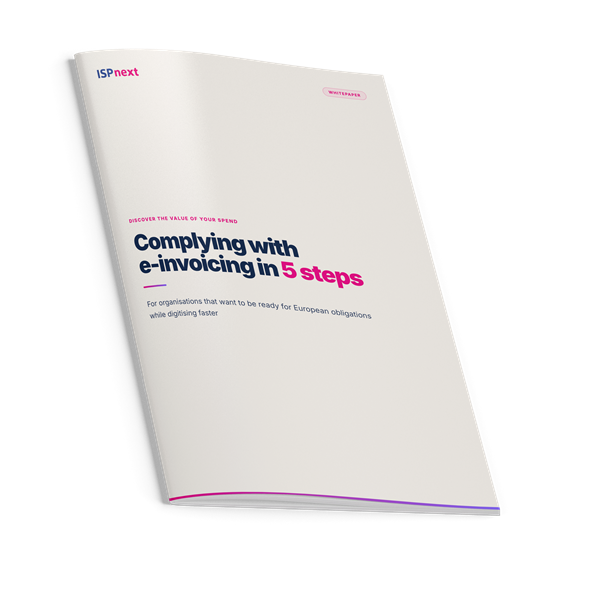
E-invoicing in 5 steps
This whitepaper explains how to prepare your invoicing process step by step for the European e-invoicing requirements. You will gain immediately applicable insights into how to digitise securely and efficiently while maintaining control over compliance.
Why is e-invoicing becoming mandatory in the UK?
The European Union’s VAT in the Digital Age (ViDA) initiative is driving the adoption of e-invoicing and real-time VAT reporting across Europe. Although the United Kingdom is no longer part of the EU, similar digital measures are being developed under Making Tax Digital (MTD) and through HMRC’s ongoing efforts to modernise tax administration.The UK government encourages the use of electronic invoicing in public procurement and B2B transactions, aligning with international standards such as Peppol. While not yet mandatory for all UK businesses, upcoming regulations are expected to expand these requirements across more industries to increase transparency, reduce VAT fraud, and improve financial efficiency.
Many European countries, including Italy, France, Germany, and Belgium, have already made e-invoicing compulsory for business-to-business transactions. The United Kingdom is observing these developments closely. Early adoption allows British organisations to remain competitive and ready for future compliance requirements.
Benefits of switching to e-invoicing
Beyond compliance, e-invoicing offers major operational and financial benefits.
- Lower processing costs: By removing manual tasks such as data entry and validation, organisations can reduce administrative costs by an estimated £3 to £8 per invoice.
- Faster payments: Automated processing shortens approval times and improves cash flow and supplier relationships.
- Fewer errors and fraud risks: Standardised formats improve accuracy and minimise the risk of duplicate or false invoices.
- Greater financial visibility: Real-time dashboards provide insight into outstanding payments, liabilities, and cash flow trends.
- Sustainability benefits: Digital invoicing reduces paper use and energy consumption, supporting environmental goals.
In essence, e-invoicing enables smarter financial management, stronger supplier collaboration, and long-term cost savings.
How to send and receive e-invoices
Switching to e-invoicing can be straightforward with the right approach.
-
Analyse your current process
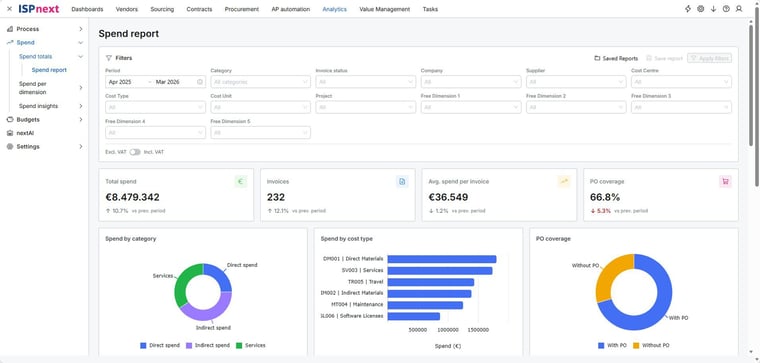
Review how many invoices you process monthly, how many are still handled manually, and where delays or errors occur. Tools such as Spend Analytics can help identify improvement opportunities. -
Check your systems
Verify whether your ERP or accounting software supports UBL or XML formats and whether it can connect to Peppol. If it cannot, consider adopting solutions like AP Automation from ISPnext, which integrates easily with existing systems. -
Engage your suppliers
Identify which suppliers can already send or receive e-invoices and which may need guidance. Support them with clear communication, frequently asked questions, and technical documentation. -
Ensure compliance
Choose a platform that aligns with UK and international standards, offers multilingual templates, supports local VAT rules, and provides audit-proof archiving. -
Train your team
Assign clear responsibilities for validation, approval, and issue handling. Training helps employees understand the process and ensures consistent use of the system.
“E-invoicing is not only a compliance solution, but also an opportunity to demonstrate financial leadership within your organisation.”
 John SchoutenDirector Product Management | ISPnext
E-invoicing for government suppliers
Public sector organisations in the UK increasingly require suppliers to submit invoices electronically through recognised platforms such as Peppol. Adopting e-invoicing early helps businesses meet government expectations and positions them favourably for future contracts.Mandatory B2B e-invoicing in Belgium starting January 1, 2026
As of January 1, 2026, mandatory B2B e-invoicing in Belgium will become a reality, a crucial step in the digital transformation of electronic invoicing across Europe. Previously, it was sufficient to send invoices as PDFs via email, but under the new regulations, invoices must be exchanged in a structured digital format. John Schouten, Director of Product Management at ISPnext, explains: "The obligation not only applies to sending structured e-invoices but also to receiving and processing them automatically."
Businesses will need to adapt their IT infrastructure, workflows, and e-invoicing software to meet these compliance standards. This shift emphasizes the need for seamless system integration and structured invoice data to build a future-proof financial administration.
Conclusion: Get ready for the future of invoicing
E-invoicing is more than a regulatory change. It is a strategic opportunity to modernise financial operations, reduce costs, and gain better control over your organisation’s finances. Companies that embrace e-invoicing today will be more efficient, compliant, and competitive tomorrow.“At ISPnext, we believe that simplicity creates speed, control, and peace of mind in finance. E-invoicing plays a key role in achieving this,” concludes John Schouten.
Frequently asked questions
E-invoicing, or electronic invoicing, is the digital exchange of invoice documents between a supplier and a buyer through a structured data format. It removes the need for paper or PDF invoices.
As of now, e-invoicing is not mandatory for all businesses in the UK. However, public sector e-invoicing may require compliance with standards like Peppol, especially in cross-border transactions.
The benefits of e-invoicing include reduced invoice processing costs, faster payments, improved accuracy, and better compliance with tax and regulatory requirements.
Start by choosing an e-invoicing software provider that supports UK e-invoicing standards like Peppol. Integration with your existing ERP or finance system is often possible.
An e-invoice is structured data sent directly between systems, while a digital invoice is typically a PDF or image sent via email. Only e-invoices meet the full compliance criteria for automation.
Yes, e-invoicing is especially beneficial for mid-market businesses and SMEs aiming to scale efficiently while maintaining compliance and reducing manual finance operations.
Most modern e-invoicing solutions offer ERP integration, allowing automated invoice creation, sending, and reconciliation.
Peppol is a standard for secure cross-border e-invoicing. It is increasingly used in the UK public sector to ensure interoperability and regulatory compliance.