
Up-to-date supplier data ensures compliance. Discover insights with ISPnext.
Regulation is mounting
Legislation increasingly demands demonstrable insight into your own chain.
Data sits scattered
Supplier details often live in separate systems and go out of date quickly.
Step by step
A fixed roadmap makes collecting and maintaining data manageable.
"In particular, ever-increasing legislation, both national and international, is fuelling an urgent need for availability and proper management of up-to-date supplier data," says Maarten de Ru, Director Product, Partner & Solution Consulting at ISPnext, developer of Source-to-Pay software. De Ru is referring to legislation around privacy (AVG), cyber and data security (NIS2 and DORA) and corporate sustainability (CSRD, CSDDD and EUDR). "These regulations are becoming more comprehensive and will apply to more and more companies."
Intrinsic motivation
The need for data is growing within companies and public institutions partly from an intrinsic motivation. "From the realisation that suppliers have a direct impact on your products and services. You want a guarantee that the entire chain fits within your sustainability and working conditions requirements. You want to know who you are actually doing business with and also have the risks for future supplies mapped out, so that you are agile when circumstances change."
Vendor Management in 5 steps
Get the whitepaper and discover in 5 steps how to optimise Vendor Management and get maximum value from your supplier relationships.
Issues
De Ru notes that in many places, supplier data is now out of order. "It is often unclear which data should be inventoried and where it should come from. The next challenge is to unlock the stored data to meet reporting requirements. In practice, much is repaired after the fact. That is labour-intensive, costly and therefore frustrating. While you can automate a lot."
Roadmap
To help organisations get started in retrieving, capturing and unlocking supplier data, ISPnext has created a roadmap. Dirk Jan Leppers, Pre Sales Consultant at ISPnext, explains the steps.
1. Vision and strategy
First of all, define the goals. Which legislation applies to me? In which risk environment am I operating? And what supplier data do I need for that? In short: map the landscape.
2. Separate responsibility
Data are often scattered throughout the organisation: some in Legal, some in Finance, Supply Chain, and so on. Make one person (or several) fully responsible for supplier data and make sure there is a clear picture of the desired situation per supplier.
3. One database
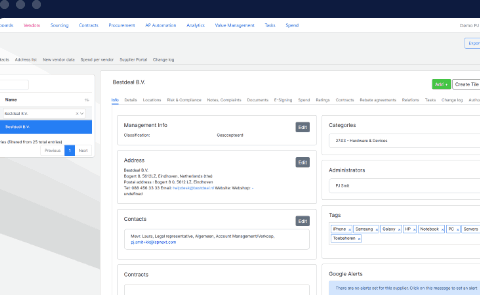
Make sure you have the right tools at your disposal. Use one source for managing supplier data. It is too voluminous and complex to keep track of in Excel, let alone on paper. And a traditional ERP system is often not suitable for all functions and requirements.
4. Segment suppliers
The impact of a facility service provider is different from that of a commodity supplier. Classify suppliers according to aspects such as cost impact, compliance, security of supply, for example, and then determine what you need to know about which parties.
When a new supplier presents itself, that is the moment to request necessary information, about certifications for instance. Make use of this momentum. The supplier will then want to cooperate, because it is in his interest to do so. Once in operation, this is a lot more difficult.
6. Use existing platforms
Do not bother suppliers unnecessarily by requesting everything from them. A lot of information is available on platforms. Think of the Chamber of Commerce, but also parties like IntegrityNext, GraydonCreditsafe, Hellios, Dun & Bradstreet.
Leppers stresses that the Source-to-Pay platform has links to such third parties. "That sharing of existing data is what we call silo unlocking," he says.
“To help organisations get started in retrieving, capturing and unlocking supplier data, we have created a roadmap.”
 Dirk Jan LeppersProduct Manager | ISPnext
Supplier data as USP
"Take the subject of supplier data seriously," Maarten de Ru wants to emphasise in conclusion. "You can't just add this in Excel or something. Controlling the supply chain can be smarter and more efficient, it really can be automated." He still often sees an audit query degenerate into a very labour-intensive project. "Accountants are specially hired to collect all the data and fill in reports correctly. An expensive joke, especially as it has to be repeated regularly."
According to him, good supplier data will eventually be a real USP. "It is becoming increasingly important to have a grip on your data. Not only regulators but also clients require you to be able to account for the entire chain. Having access to and being able to easily access data is crucial."
This article was produced in collaboration with CMweb.