


<img src="https://secure.leadforensics.com/51974.png" style="display:none;">

Oracle JD Edwards × ISPnext: real-time control over financial processes

Oracle JD Edwards provides a powerful ERP foundation for organizations with complex financial processes. But getting a real grip on invoice processing, obligations and compliance requires more than just robust financial administration.

The Oracle JD Edwards integration with ISPnext creates one streamlined, governance-focused Source-to-Pay process in which workflows, matching and approval rules are centrally managed and financial data is synchronized in real time.

ERP profile enrichment_Oracle JD Edwards

What is an Oracle JD Edwards integration?

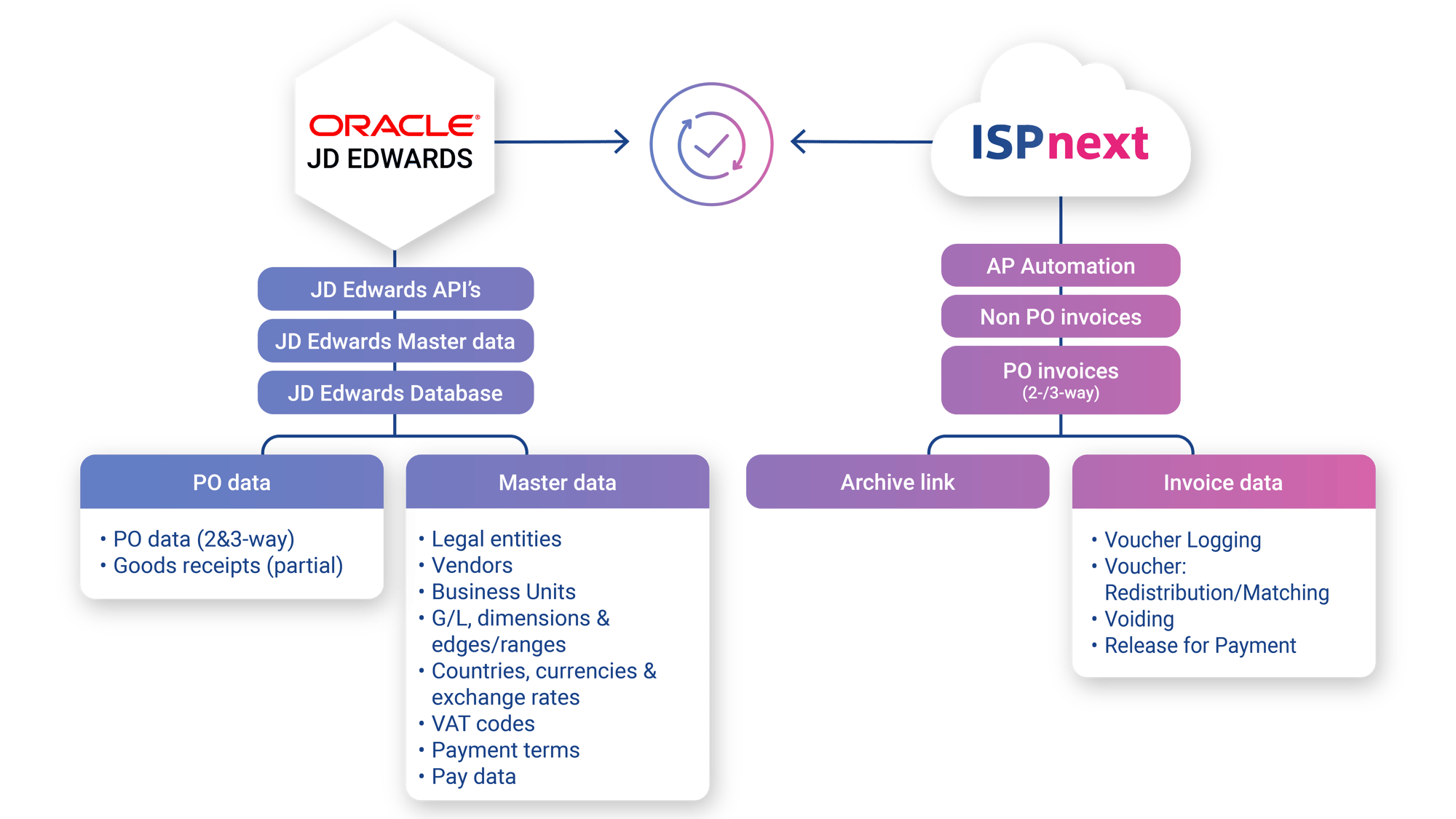
An Oracle JD Edwards integration links Oracle JD Edwards EnterpriseOne directly to the processes within ISPnext. This synchronizes master data, financial entries, orders and receipts and other relevant data in real time.

JD Edwards remains the ERP system-of-record, while ISPnext standardizes, automates and audits operational processes.


Benefits of an Oracle JD Edwards integration

Icon_Time to Value_blue

Less manual work

Matching, validation, invoice processing and status updates are automated.

Icon_Realtime insights_purple

Unburdening through standardization

Less customization, less complexity and fewer manual actions in finance and procurement.
Icon_Higher compliance_pink

Unburdening through standardization

Less customization, less complexity and fewer manual actions in finance and procurement.

Technical steps of a JD Edwards integration

The integration with Oracle JD Edwards consists of a number of technical building blocks that ensure that data is exchanged correctly, on time and without duplicate operations. This creates a stable process in which master data, bookings and invoice processing fit seamlessly together.

1. Master data synchronization

2. Reconcile financial entries

3. Linking orders & receipts

4. Processing outages

5. Error handling & monitoring

Sage_Step 1

1. Master data synchronization

Suppliers, general ledger, VAT codes and other master data always remain up-to-date.

Sage_Step 2

2. Reconcile financial entries

Bookings are exchanged without manual processing or duplicate registration.
Sage_Step 3

3. Linking orders & receipts

Essential for 2-way and 3-way matching.
Header_ISPnext_DACH

4. Processing outages

Corrections are applied consistently in both systems.
Sage_Step 5

5. Error handling & monitoring

Deviations are immediately flagged and neatly incorporated into workflows.
Story - Shurgard - Photo
"The combination of Oracle JD Edwards and ISPnext provides faster processing, greater visibility and better control over the billing process."

- Steve Vancraenem, Director of Accounting Europe | Shurgard

Live with ERP: from Oracle JD Edwards data to a smarter Source-to-Pay process

With a real-time Oracle JD Edwards ERP integration, you work fully live with ERP data within the entire Source-to-Pay chain. Procurement, invoice processing, approval and payment management run in one standardized workflow, based on up-to-date data from JD Edwards.

Functionalities of the Oracle JD Edwards integration

  • 2-way matching
  • 3-way matching (PO + receipt + invoice)
  • Automatic processing of additional charges
  • Archiving of documents and audit trail
  • Payment management with status updates
  • Support of G account flows

ISPnext - Dataflow - Connector - SAP

Which organisations benefit most?

Finance teams

For organizations that value reliable numbers, insight and error-free processing.

Procurement departments

For teams that want to put PO-driven processes and governance at the center

IT departments

For organizations that want to keep JD Edwards as a stable ERP foundation but want to modernize processes.

Talking to customers with JD Edwards integration

For organizations working with Oracle JD Edwards, stable processes, control and reliability are essential. This is precisely why many companies opt for a solution that integrates seamlessly with their existing ERP environment. In practice, JD Edwards users mainly notice the benefits of less manual work, greater insight into financial processes and a better grip on compliance and workflows.

Icon_AP automation_2x_cropped

5 tips for a Source-to-Pay implementation

Download the white paper and discover five practical tips to make your Source-to-Pay implementation faster and smarter.


Mockup_Preview_5 tips for a successful Source-to-Pay implementation (NL)

Frequently asked questions about Oracle JD Edwards integration

What is an Oracle JD Edwards integration?

A link between JD Edwards and ISPnext for real-time data exchange and process automation.

What data is synchronized?

Master data, entries, orders, receipts, invoice information and status updates.

What are the benefits of a JD Edwards integration?

Real-time visibility, less manual work, compliance and better control.

How does a JD Edwards integration help automate invoice processing?

Through automatic recognition, matching and standardized approvals.

Does an SAP integration support 2-way and 3-way matching?

Yes, an SAP integration can support both 2-way matching and 3-way matching.

Does the integration support 2-way and 3-way matching?

Yes, completely.

Does it work for both on-premises and cloud JD Edwards?

Yes.

Which organizations are suitable for?

Finance, procurement, IT and organizations with complex processes.

How does this increase compliance?

Through audit trail, roles, authorizations and standardized processes.

What does real-time synchronization provide?

Up-to-date numbers, fewer errors and better reporting.