
Find out how the DICO Sales005 e-invoicing standard helps companies in the construction industry to digitise and streamline invoicing processes.
The standard
SALES005 defines how construction invoices are exchanged digitally.
The gain
Less manual retyping and faster processing on both sides.
Supported
ISPnext processes the standard without custom work per supplier.
Millions of invoices are sent by construction organisations every year. Processing invoices takes a tremendous amount of time and money. In 2019, it became mandatory for contracting authorities to send and be able to receive e-invoices according to the EU Directive. As of 1 January 2022, it is also mandatory in the construction industry to process and send invoices via e-invoicing.
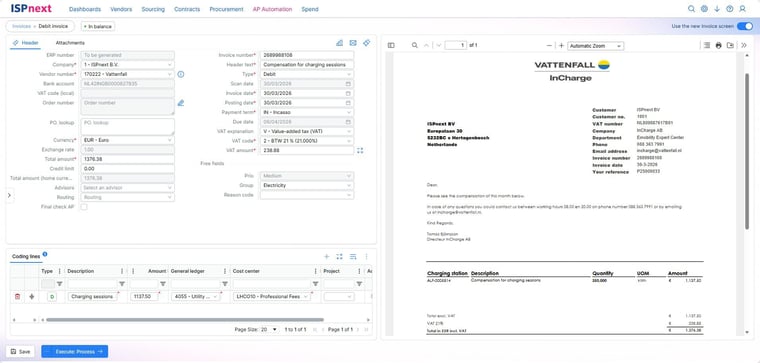
DICO's version SALES005 enters the construction industry to make the process more efficient, faster and more economical. It is an initiative of a number of construction and installation companies together with Foundation Chain Standard. ISPnext's AP Automation solution supports this standard for all of our customers. This means you can invoice with a single XML format, SALES005.
What exactly is the DICO Standard version SALES005?
The DICO Standard version SALES005 is a set of agreements between manufacturers, wholesalers, construction, maintenance and installation companies and housing associations on what should appear where in an electronic invoice.
An electronic invoice, also known as an e-invoice, is a structured, digital file (not a PDF file). In this, all data are always in a fixed place. An e-invoice can be processed electronically from one automated system into another.
E-invoicing in 5 steps
Discover how to adopt e-invoicing without custom work per supplier.
Benefits of e-invoicing
Unlike a paper invoice or an email with an invoice as a PDF attachment, an e-invoice can be automatically transferred electronically from one system to another. The three main benefits of e-invoicing according to DICO version SALES005:
- More accurate: no more human actions required since the invoice is automatically passed on.
- More organised: the information is always in the same place in the invoice. No more variations in format. An e-invoice is checked for IBAN, VAT number and Chamber of Commerce number. For invoices according to DICO version SALES005, the GLN code is added. As a result, phantom and duplicate invoices are easily intercepted.
- Faster processing: e-invoices are processed faster, which allows you to pay faster and build a better relationship with your suppliers. On average, an e-invoice is paid seven days earlier than a paper invoice.
ISPnext supports the standard
ISPnext supports various (international) electronic billing standards such as SALES005 with AP Automation. Incoming e-invoices can be received and processed in various XML formats.
Major construction organisations and ISPnext users, such as Unica, are adopting this new standard as an industry initiator. Are you ready to process electronic invoices via the SALES005 standard?